

Eight people at work in a small office bay. One woman stands mid explanation with both hands open while two colleagues listen; the rest work at desks stacked with paper files and folders.
Payment dispute management for banks, credit unions, acquirers and processors worldwide

Every claim arrives with two clocks already running.

Dispute volume is growing. Automate the response. Lean's platform holds both clocks, the regulator's and the network's, in the case file, routes the exceptions to your analysts, and moves everything else from claim to resolution on its own.

Lean Industries builds payment dispute and chargeback management software for banks, credit unions, acquirers and payment processors: one engine, configured to the operation, integrated natively with Visa, Mastercard and the connected debit networks.
SOC 2 Type II

Lean has completed its System and Organization Controls (SOC) 2® Type II examination. Report issued July 2026.

72%1

Less time to resolve a dispute at a global acquirer running AdjustmentHub; the team that needed seven people now needs three.

Rabobank

A leading Dutch multinational bank automated a significant part of its Visa and Mastercard dispute processing. Read the case study →

1 Client outcome, anonymized, reported in 2025: average time to resolve a dispute fell from 18 days to 5, and the team that needed seven people now needs three. More on this result →
01Who USEs OUR PLATFORM

Where you sit in the dispute cycle.

One platform, seen from the seat you work from. The dispute logic is the same; what changes is the job in front of you.

The dispute cycle, drawn once: cardholder, issuer, card network, acquirer, merchant, with the processor or partner across it, and the way back through the network. The three seats marked.
Issuer

Banks and credit unions

Work cardholder disputes end to end: initiation, chargeback cycles, representment response and case filing, with Reg E, Reg Z and network clocks running on every case.

Runs as: an enterprise deployment, configured to match your operation.
Acquirer

Merchant-side operations

Manage inbound chargebacks at volume: second presentments, evidence assembly and fee handling on the same engine, against the same rails.

Runs as: the same engine, with acquirer workflows native to it.
Processor or partner

Program operators

Operate dispute programs on behalf of many institutions from one configured platform, at processor scale, with per-institution policy held in configuration.

Runs as: multi-institution configurations, in production today.
02What we solve

The problems on a dispute desk.

Four problems an issuer, an acquirer or a processor brings to the dispute desk.

Chargeback operations

Case volume grows. Headcount doesn't.

Manual queues age, network clocks keep running, and each escalation pulls an analyst off the cases that need judgment.

The engine automates the repeatable path (intake, eligibility checking and straight-through processing) so the team works the exceptions, not the backlog.
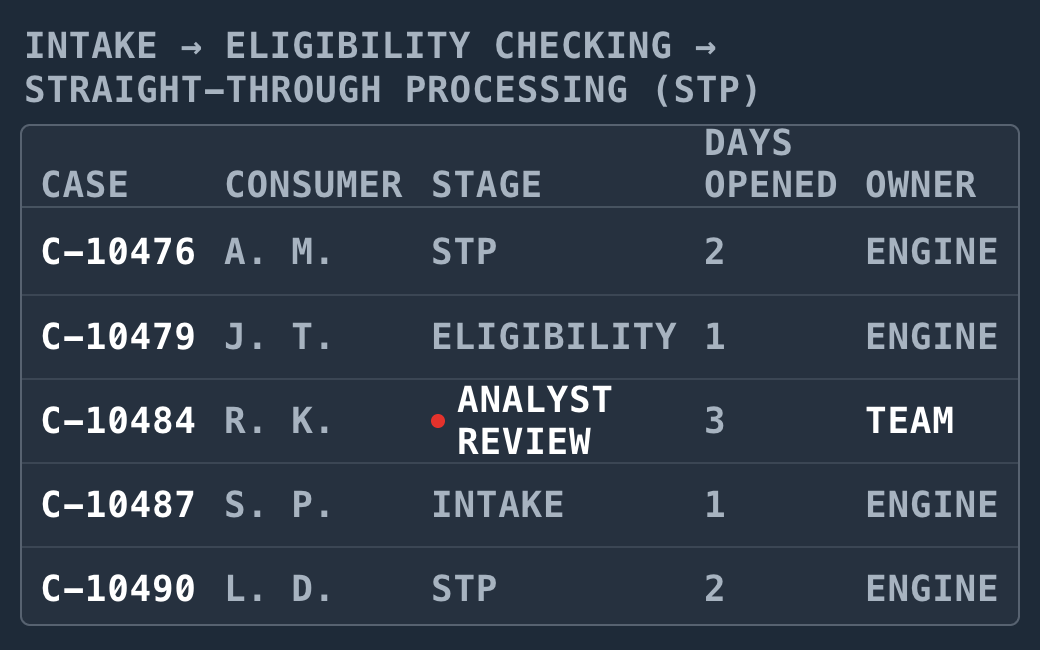
A working queue of five cases. Each case enters at intake and moves through eligibility checking and straight-through processing with the engine as owner; C-10484 stops for analyst review and passes to the team.

Regulatory deadlines

The clock is regulatory, not operational.

Investigation windows, provisional credit timing, documentation standards: the deadlines are set by regulation and network rules, and missing them is its own loss category.
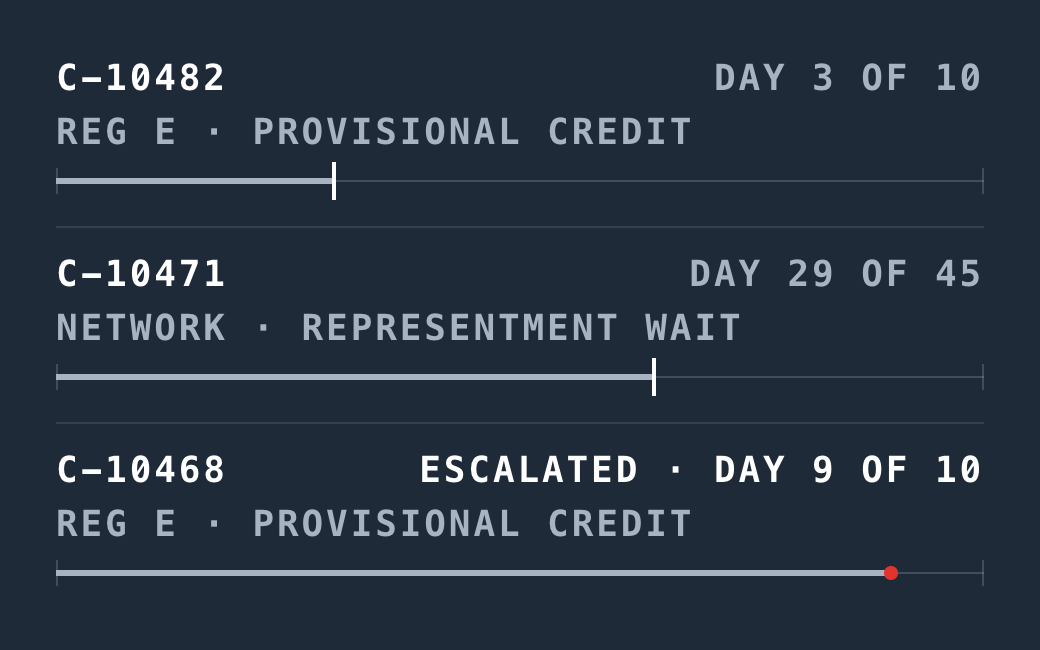
The workflow carries the clocks. Every case knows its deadline, and every action lands in the audit trail as it happens.

Three cases and their timers: C-10482, Reg E provisional credit, day 3 of 10; C-10471, network representment wait, day 29 of 45; C-10468, Reg E provisional credit, day 9 of 10, escalated before its deadline.

Network integration

Disputes shouldn't leave the workflow to reach the network.

Swivel-chair work, keying a case in one system and again in the network portal, is where time and accuracy are lost.
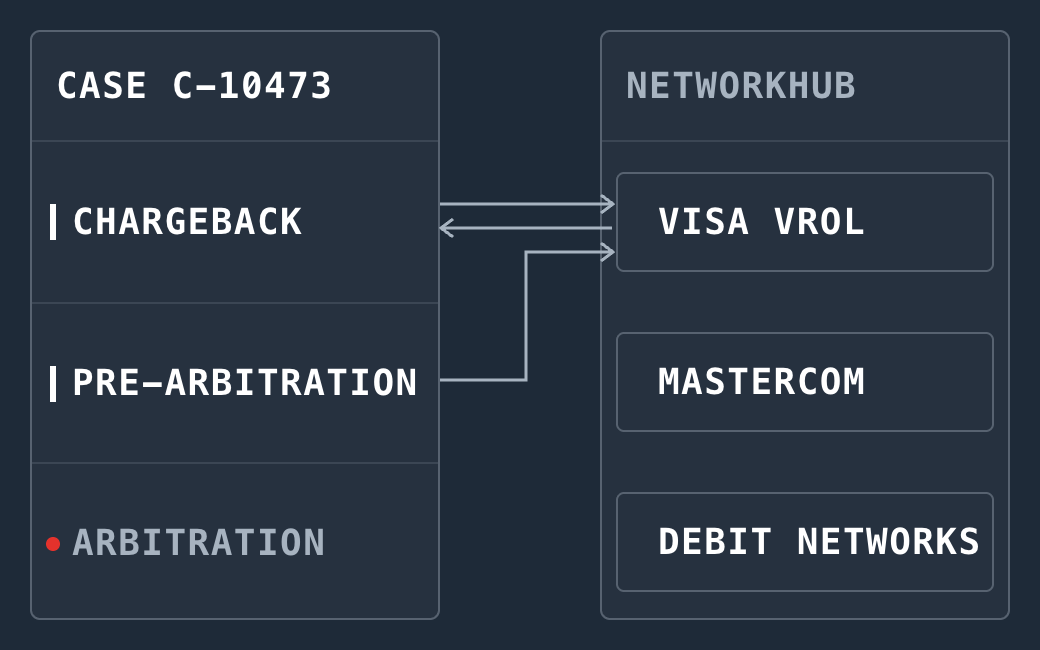
Cases move to and from Visa VROL and Mastercom without leaving the workflow. The network connections are built into the core, not bolted on.

One case, C-10473, through NetworkHub to Visa VROL: the chargeback filed, the representment back on the same record, the pre-arbitration filed; arbitration, the issuer's decision, not yet reached. Mastercom and the debit networks are on the same layer.

Recovery and write-offs

Write-offs should be a rule, not a default.

When handling a chargeback costs more than the claim is worth, recovery stops at the write-off threshold.
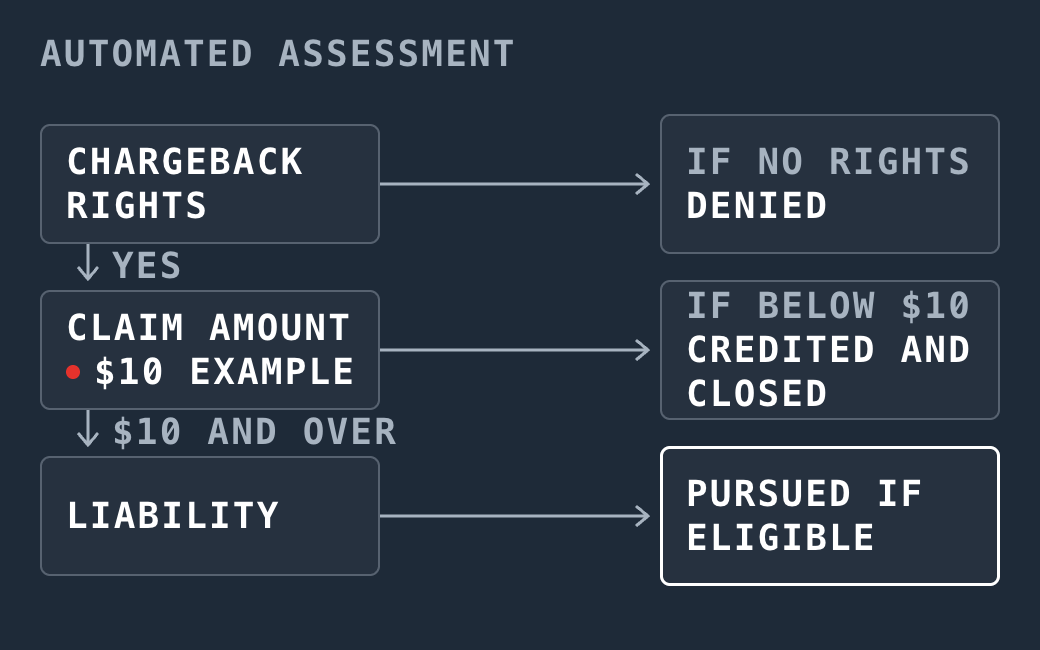
Automated assessment changes the economics: below the write-off threshold you set, a claim is credited and closed; at or over it, an eligible claim is pursued. Because the assessment takes no analyst time, the threshold can sit lower.

Automated assessment checks chargeback rights, then the claim amount against an example write-off threshold of $10, then liability. With no chargeback rights the claim is denied; below $10 it is credited and closed; at $10 and over it goes on to liability and is pursued if eligible.
03Platform

One dispute engine, configured to your operation.

Your policy, portfolio and process are held in configuration, and the tools to change them stay with your team. When a network changes its rules, Lean updates NetworkHub and AdjustmentHub.

Enterprise deployment

AdjustmentHub

Every dispute runs on one engine, from intake to network resolution, with twenty years of dispute logic built in. Each deployment is configured to match unique enterprise requirements.

Explore AdjustmentHub →
Integration layer

NetworkHub

The network connections inside AdjustmentHub: Visa VROL, Mastercom and the connected debit networks.

Explore NetworkHub →
04Resources

The operator's library.

GuideREF 01
Why institutions automate disputes

Dispute volume moves with e-commerce and fraud while headcount does not. What dispute automation does, what it changes, and what to look for, with sources.

Read the guide →
GuideREF 02
Reg E dispute timeframes, explained

Reg E dispute timeframes in one table: the 10, 20, 45 and 90 day clocks, the notices, which transfers are covered, and what automation does at each step.

Read the guide →
GuideREF 03
Visa VROL and Mastercom, explained

A plain reference to Visa VROL and Mastercom: the dispute stages side by side, allocation and collaboration, reason codes and Compelling Evidence 3.0.

Read the guide →

See how AdjustmentHub performs against your dispute volume.

Thirty minutes with a dispute specialist, built around your own volume and networks.

What happens next
A dispute specialist gets in touch to book the call.
We ask for your rough monthly dispute volume, the networks and payment types you run, and the systems a dispute passes through today.
On the call, the specialist models how AdjustmentHub could shorten your time to resolution.

We use this to arrange the demo. No phone number needed. See our Privacy Policy.

Thank you! Your submission has been received!
That did not send. Use the contact form or call +1 937 639 8122 and we will set a time from there.